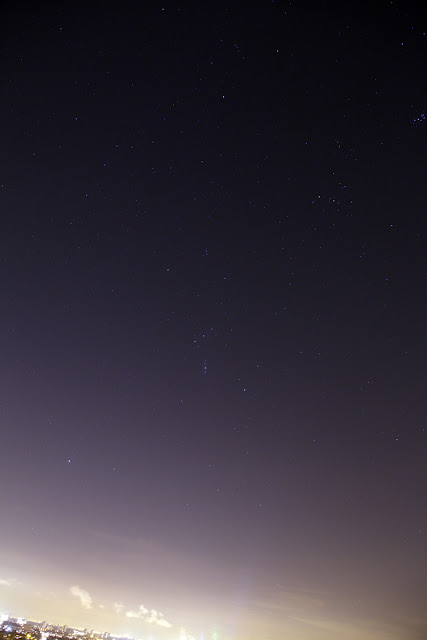
Several "single shot" images made last summer in France with an astro-modified Canon 5D Mark II and Canon EF 24 -
70 mm f/2.8 L USM lens. Most of the images have been made at 24 mm
f/2.8 - f/4 at ISO 3200 or ISO 6400. Exposure times of 30
to 90 seconds.
Friday, 21 December 2012
Sunday, 28 October 2012
Messier 76, Little Dumbbell Nebula
This was my second night out with the Astrosib 250. Although the sky looked very clear during twilight, clouds appeared just when I wanted to start the first exposure. After a short while the clouds luckily disappeared. I run a script (in Nebulosity) to capture light through Ha (7 nm) en OIII filters (8.5 nm), which alternated with each other after each exposure. Exposure times were 20 minutes per subframe. Eventually 5 Ha subs and 6 OIII subs were usable to combine. Other subs were lost during haze and/or clouds and for the simple fact M76 disappeared behind the roof of my house.
Processing was partly done in Photoshop (CS6) and party done in PixInsight. For me it was the first time to really use PixInsight for processing and I liked it. The tools used were deconvolution (Richardson-Lucy, only on M76), AtrousWaveletTransform (noise reduction in the background) and DynamicBackgroundExtraction (slight correction for vignetting).
Shown are the full field of view (slightly cropped), crop at 50% resolution and crop at full resolution.
Processing was partly done in Photoshop (CS6) and party done in PixInsight. For me it was the first time to really use PixInsight for processing and I liked it. The tools used were deconvolution (Richardson-Lucy, only on M76), AtrousWaveletTransform (noise reduction in the background) and DynamicBackgroundExtraction (slight correction for vignetting).
Shown are the full field of view (slightly cropped), crop at 50% resolution and crop at full resolution.
Sunday, 23 September 2012
New telescope and first light pics
Recently I've received my new telescope: a 25 cm f/8 AstroSib Ritchey-Chrétien. This Russian made machine is built like a tank. A friend of mine called it "beautiful because of its ugliness".
Sky conditions were far from good last night, but good enough for a serious first light: the Gulf of Mexico (a.k.a. The Wall) @ F = 1420 mm f/5.7 (Astro-Physics CCDT67 reducer). Exposed 9x 20 min. with an SBIG ST-8300M and Baader 7 nm H-alpha filter. Full field of view and crop at full resolution.
Saturday, 15 September 2012
The harvest of this years summer visit to France
Each summer, several friends and I try to spend a week in Southern France for pursuing astrophotography. Since 2006, the pension "Les Granges" of Oliver Penrice in Étoile-Saint-Cyrice has become our favourite spot. As Olly would put, we form a group of "regular guests". Les Granges offers dark skies (21.5 magnitude per square arcsecond) and therefore a lot of astronomy fun.
This year, we stayed at Les Granges from August 17 tot 24. Almost every night offered clear skies during the whole night, so a lot of imaging data could be acquired. Here are my results.
Timelapse Étoile-Saint-Cyrice, summer 2012 from Maurice Toet on Vimeo.
This year, we stayed at Les Granges from August 17 tot 24. Almost every night offered clear skies during the whole night, so a lot of imaging data could be acquired. Here are my results.
Sunday, 15 July 2012
Jupiter Occultation
On the early morning of July 15, 2012, Jupiter was occulted by the moon. To witness this relatively rare event, I packed my car with astronomy equipment, went to bed early and set my alarm at 2:00 a.m. (my wife kindly requested me to sleep on the coach...). When the alarm went off, I quickly took a peek outside: rain. No worry, this was exactly what the weather forecast predicted. The skies would clear just before dawn, so time to go to a place outside town with a clear view to the east.
I arrived around 2:45 a.m.. The occultation would begin at (or around) 3:52 a.m. so I had time enough to set up the equipment. In the meantime it had stopped raining. I could already see several of the brighter stars. There were too many clouds to completely witness the start of occultation, but luckily for me, the final patches of clouds disappeared, so I was able to observe (and photograph) the rest of the event.
Technical details of the pictures can be found on my website.
I arrived around 2:45 a.m.. The occultation would begin at (or around) 3:52 a.m. so I had time enough to set up the equipment. In the meantime it had stopped raining. I could already see several of the brighter stars. There were too many clouds to completely witness the start of occultation, but luckily for me, the final patches of clouds disappeared, so I was able to observe (and photograph) the rest of the event.
Technical details of the pictures can be found on my website.
Labels:
Jupiter,
Moon,
occultation
Location:
Zoetermeer, The Netherlands
Subscribe to:
Posts (Atom)